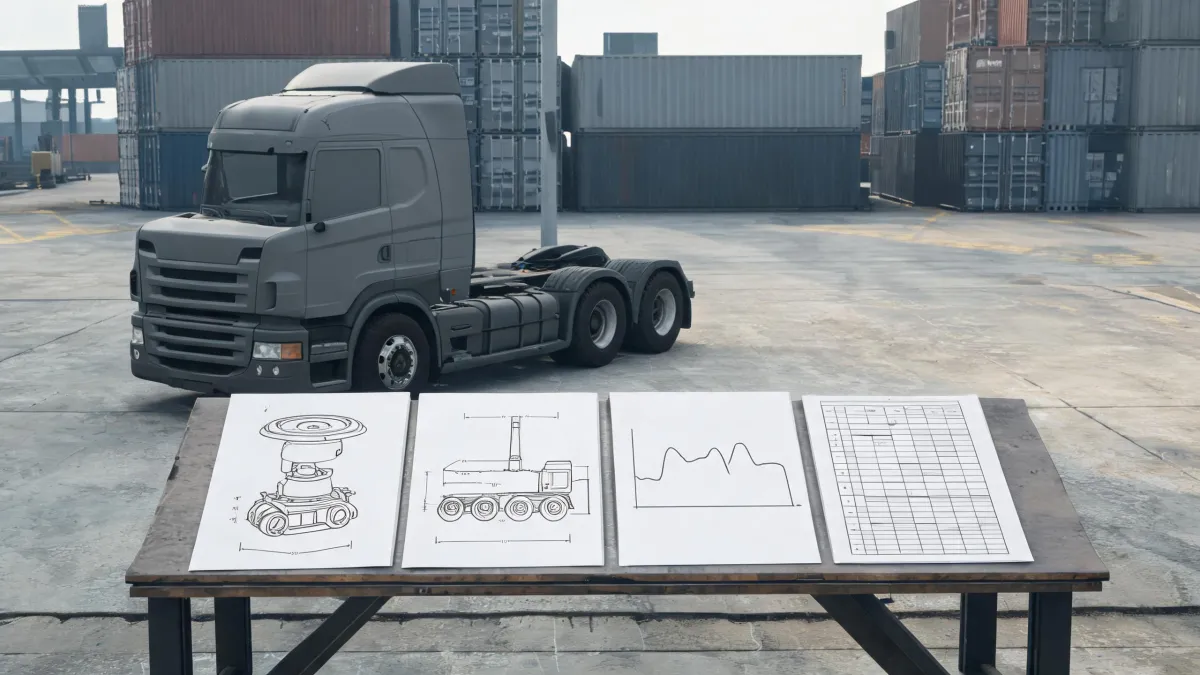
You maintain a fifth wheel plate by matching the routine to the plate that is actually on the tractor, not by picking a grease and a schedule. On a Freightliner Business Class M2, a standard fifth wheel plate must be kept well lubricated with chassis grease to prevent friction and binding between the tractor fifth wheel plate and the trailer, while a low-lube plate is handled by inspecting the pads and leaving the grease gun in the box. Plate type is the condition that decides the whole job, so look before you spend.
The wording here comes from the Business Class M2 driver's manual, STI-455, revised February 2025, and it is model-specific. Another chassis may split the same two plate families differently or use a plate neither name covers. Buyers looking at a used tractor and fleet hands doing a pre-trip walkaround hit the same fork from opposite ends: the buyer wants to know whether the previous owner kept up, and the driver wants a check short enough to survive a bad morning. Both questions start under the trailer nose.
Find Out Which Fifth Wheel Plate You Have
The routine follows the plate, and which plate is bolted to the tractor shows without tools. A standard fifth wheel plate is bare steel riding against the trailer's upper plate, and it is the type that has to be greased and kept greased. A low-lube plate carries pads instead, and the instruction flips: inspect the condition of the low-lube pads, and there should be no damaged or missing pieces.
Those are opposite actions, so the first five minutes of ownership should go into identifying which one you have. Pads you can see under the trailer nose mean the low-lube type, and chassis grease is not the routine for it. Bare steel with a polished track worn into it means a standard plate, and grease is the routine. Suppose a tractor came out of a fleet where nobody ever crawled under the nose: a plate that has been greased for years when it should have been inspected, or the reverse, is possible, and the previous owner's word cannot settle it. Judge it by what is bolted there, not by what you were told.
A buyer and a driver want different things from the same check, and both get them. The buyer wants to know what upkeep the truck has had, and the plate tells you which routine the seller should have been running. The driver wants something short enough to survive a bad morning, and a two-minute look under the nose is the quickest way to keep the rest of the routine honest.
What the Grease Is Actually Preventing
The grease buys friction control at the sliding interface, and that is the whole of its job. Chassis grease on a standard plate is tied directly to stopping friction and binding at the joint, because the trailer's upper plate pivots and slides across the tractor plate every time the combination turns. A dry plate is metal dragging on metal through every corner, and you feel it in the wheel before you have seen anything wrong underneath.
Because the symptom is resistance rather than a visible defect, a dry plate hides well. Imagine looking at a used tractor on a dealer lot: the plate is intact, no cracks, no obvious damage, and nothing in a walkaround tells you whether it was greased last week or last spring. Ask what the routine has been, then decide what a plate that has run dry is worth to you. If the rest of the truck is sound and the price reflects the gap, it is a negotiating point. If the seller cannot answer the question at all, that silence is information about how the whole unit was treated.
The trade-off is blunt. A few minutes with a grease gun is a short job, and it is the right spend only when there is bare steel under there. Point that gun at a low-lube plate and you have bought nothing for the part that actually wears.
What Normal Low-Lube Pads Look Like
The low-lube pass line is more forgiving than most owners expect. The condition to check is simple: no damaged or missing pieces, and slight puckering at the outside edges is normal. Edge puckering looks like damage to someone seeing it for the first time, which is exactly why people order pads they did not need. A missing piece or a damaged pad is a different category, and that is the one that moves a plate out of fine and into needing attention.
If every pad is present with only slight edge puckering, skip the pad purchase and put the money into something else on the tractor. If a piece is damaged or gone, that is the condition worth acting on, and the next step is the fifth wheel assembly manufacturer's own instructions for that unit rather than a generic pad-swap guess. This is also the check a buyer should insist on before signing: pads are a replaceable item and awkward to check at speed, so a seller who will not let you look under the nose is telling you something.
This trade-off runs opposite to grease. Inspecting pads takes longer, needs you on your back or on a creeper, and it will never feel as satisfying as a quick shot of grease. It is also the only routine that will ever catch a pad that has gone missing, because grease was never the job on that plate in the first place.
Check the Coupling Before You Trust the Plate
Plate condition tells you nothing about whether the trailer is actually attached, and those are two separate failures. Coupling is activated with the lock control handle located on either the right or left side of the fifth wheel, and coupling has successfully occurred when the kingpin has been forced into the jaws and the lock control handle has moved to the locked position. Both parts, not one of them.
Handle position alone is a weak check if you only glance at it from standing height. Get down and look at the jaws with the kingpin seated, then confirm the handle is where the locked position puts it. If the handle has not moved to the locked position, coupling has not happened by the definition in the manual, and holding the unit for another two minutes costs nothing next to the alternative. Experienced drivers still get this wrong when they are tired and the handle feels like it swung through.
For a buyer, this is a free inspection that separates a maintained tractor from a tidy one. Watch the handle go to the locked position with the kingpin in the jaws during a test drive. If it does not, stop there and find out why before you talk price.
What the Sliding Fifth Wheel Rails Add to Your Check
On a sliding fifth wheel assembly, the plate is one part of a positioning system, so a plate-only routine covers only part of what that system does. The plate is attached to rails that allow forward and rearward movement of the fifth wheel to optimally distribute the load across the axles. Slots are evenly spaced along the slide rails, and retractable wedges sit through the slots to hold the fifth wheel in the desired position.
That changes what you are looking at under the tractor: three things, not one. The plate surface or its pads, the rails the plate rides on, and the wedges holding the setting you run. If the truck has spent its life at a single setting, the rails and wedges have barely been exercised and the check is mainly that nothing is visibly loose or missing. If the setting has been moved, for a different trailer or a different load, that hardware has been doing real work and it becomes the first thing to ask about.
You are trading a few extra minutes on your knees for not buying a positioning system nobody has ever inspected. On a used tractor, the second risk is usually the larger one, because slide hardware sits where nobody looks unless something has already gone wrong.
The Manual Isn't the Whole Checklist
One line in the Business Class M2 chapter carries more weight than its length suggests. The pre- and post-trip checklists, inspections and maintenance procedures detailed there are not all-inclusive, and the reader is directed to other component and body manufacturers' instructions plus local, state and federal guidelines. That line tells you where the edge of this material sits, and the edge is closer than most people assume.
The fifth wheel plate wording covers the plate. It does not cover the trailer body, it does not cover the kingpin's own wear limits, and it does not cover whatever your state's inspection rules ask for. So treat the plate routine as one layer of a longer check rather than the whole thing.
When you buy, ask for the body manufacturer's instructions that came with the trailer and confirm the current local rules rather than trusting a forum thread from five years ago. If the seller cannot produce paperwork for the body, push on it before money changes hands. Not because the plate routine is wrong, but because a plate routine was never going to be the whole inspection.
Pick Your Routine and Accept the Trade-off
The branches fall out cleanly. Go with chassis grease, kept on the plate, if you have a standard fifth wheel plate, because that is the routine the manual assigns to that hardware. Skip the grease and go with pad inspection if a low-lube plate is fitted, accepting slight edge puckering as normal and reacting only when a piece is damaged or missing. Add the coupling confirmation to the same walkaround either way, with the lock handle in the locked position and the kingpin in the jaws.
All of this is Business Class M2 wording, and that is the boundary you should hold. On any other chassis, go back to that model's manual before you commit spend, because plate type and the routine that follows from it are per-model facts. A rule borrowed from a different tractor is not a shortcut, it is a coin flip.
What you get from committing to one routine is a short check you will actually run and a plate that is not quietly working against you every mile. What you give up is the comfort of a single generic answer that applies to every tractor on the lot. That answer does not exist here: the plate under the nose decides, and every dollar spent on the other routine is a dollar that bought nothing.
