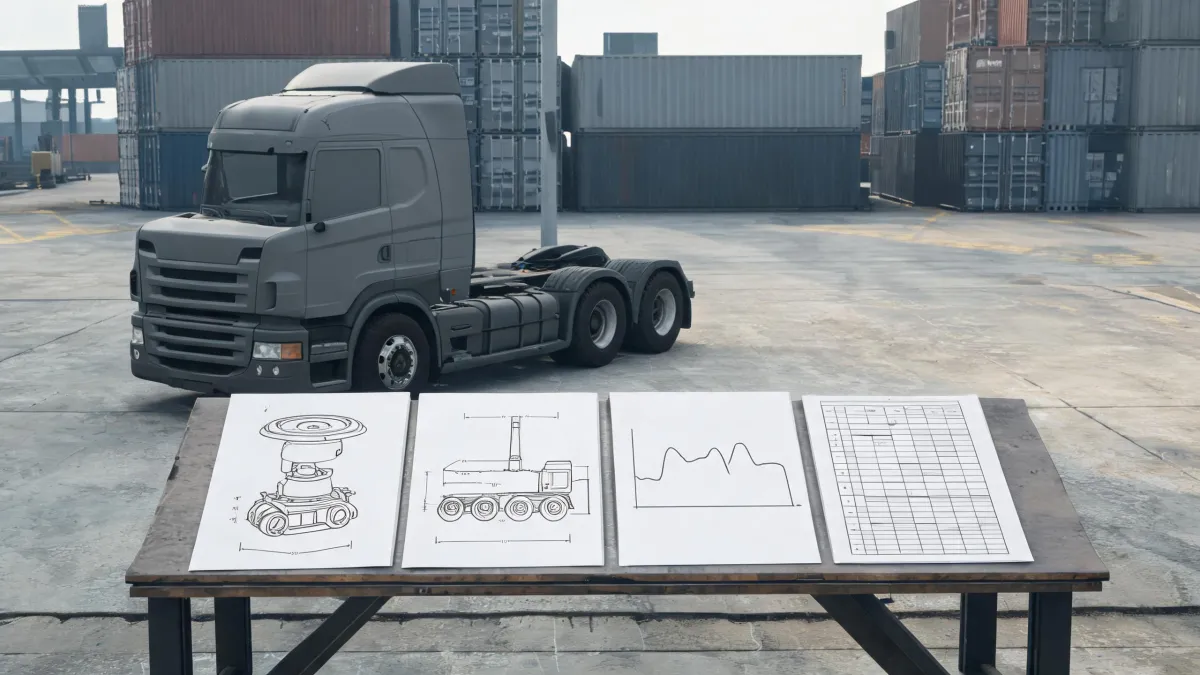
The scale house window slides open and the ticket comes out still warm: steer axle, drive axles, trailer axles, gross. The tractor is sitting on the plate with the trailer still coupled, and the person holding that slip is doing what most fleets do in that moment — reading the steer line, then the drive line, then the number at the bottom, and deciding whether to pull off or back up. Every line on that sheet can look acceptable and the combination can still be over the limit.
This is the order to work that ticket in, plus the settings that decide what the numbers come out as, described for the Freightliner Business Class M2 and the way that chassis is optioned. Other chassis follow their own manuals and their own body builder instructions. The part that gets missed is why one of those tickets can be clean and the load still illegal: the federal limit that does most of the catching is written against groups of axles rather than single ones, and a group weight never shows up as its own line.
What A Full Axle-Load Check Actually Involves
The order is set by the hardware: steer axle first, then the drive axle group, then the trailer axles, with each reading written down on its own line. Weighing on a scale built for the job is the first requirement, because front and rear axle weights come from putting the vehicle on scales designed for that purpose, not from arithmetic done on a shipping document. Each axle gets its own number rather than one gross figure, since every step after the weigh-in works off those individual readings; a gross-only ticket has nothing in it to compare against a group limit later.
Once the readings exist, they get checked against three fixed federal numbers and one computed limit. Single axles are limited to 20,000 pounds. Axles spaced more than 40 inches and not more than 96 inches apart, which is what counts as a tandem, are limited to 34,000 pounds. Gross vehicle weight is limited to 80,000 pounds. The computed limit is the bridge number covered further down, and it is the one that can fail a load the other three numbers have already cleared.
The Steer Axle Carries More Than Weight
A clean ticket says nothing about how the load is split between the steering axle and the drive axles, and that split has a direct effect on steering control — how much load sits on the front steering axle versus the rear drive axle is what governs how much authority the driver has over direction. That matters on its own, apart from any legal limit, which is why a truck can be perfectly legal and still unpleasant to point down a ramp.
It comes down to grip. A tire can only generate so much force before it lets go, and force spent carrying weight is force not available for turning. Load one end of the tractor heavily and the other end has less margin to work with. Suppose two loads with the same gross weight and the same passing axle readings: in one the freight sits forward, in the other it sits over the drives. Both tickets clear, and the truck will not drive the same, because the axle doing the steering is carrying a different share of the total. That is a setup decision made before the wheels roll, not something a driver can correct in traffic.
Sliding The Fifth Wheel Moves Load Between Axles
On a sliding fifth wheel assembly, the plate rides on rails that allow forward and rearward movement, and the purpose of that movement is to distribute load across the axles. Slots are evenly spaced along the rails, and retractable wedges pass through those slots to hold the plate at the chosen position. None of that hardware changes how much freight is on the deck.
What changes is leverage. The trailer's kingpin load lands on the plate, and the plate's position sets the distance from that load to the steer axle and to the drive group. Move the plate rearward and the lever arm to the steer axle lengthens while the arm to the drives shortens, so the steer axle sheds weight and the drive group takes it on. The reason the gross number on the ticket does not budge is that nothing was added or removed — the load was re-apportioned, which means the fifth wheel is a distribution control, not a capacity control. On a conventional tractor the useful direction is normally rearward to relieve the steer axle, but the size of the change depends on wheelbase, trailer geometry and where the freight sits, so it gets measured rather than assumed. The wedges are what hold the plate in the position you set, so the reading describes that position only while they are seated through the slots.
The Group Limit Your Scale Ticket Does Not Show
Three groups need checking, not one. The group spanning the entire combination, sometimes called the outer bridge, has to comply with the bridge formula. So do the interior groups: the tractor bridge across axles 1, 2 and 3, and the trailer bridge across axles 2, 3, 4 and 5. Federal law states that any two or more consecutive axles may not exceed the weight computed by the bridge formula even though single axles, tandem axles and gross weight are all within legal limits.
The limit attaches to combinations of consecutive axles, which means adding axles does not automatically buy payload. Spacing sits inside the calculation, so the axle count alone does not fix the allowance, and the same axle count behind a different trailer is not automatically the same answer. It also means the group that binds can be an interior one — a set of numbers you would never look at if you only read the top and the bottom of the slip.
Confirming The Weights You Wrote Down
Three checks decide whether those numbers are worth acting on. The scale has to be one designed for weighing vehicles, since a figure from anything else is a guess with a decimal point attached. The readings have to be per axle rather than a rounded gross, because a total that has been rounded can mask a group that is over. And the per-axle numbers have to be substituted back into the group checks until you can name the tight one out loud — steer and drives and trailer as a set, plus the interior combinations. If you cannot say which group sits closest to its limit, the check is not finished.
Repeat the pass on the same configuration when the answer decides something expensive, such as whether a load plan gets reworked. If two passes over the same scale leave you with numbers you can't square with each other, the problem usually isn't the scale. Something in the load or the setup moved: freight shifted, the plate was not where you believed it was, fuel or an axle configuration changed the picture. Go find the variable and weigh again rather than keeping whichever ticket reads better. This is bookkeeping on your own equipment, not a repair procedure, and anything that looks like a component fault belongs with whoever services the chassis.
Where Your Manual Stops And Route Rules Begin
Everything above is the federal Interstate picture: the single-axle limit, the tandem limit, the gross limit and the bridge formula as they apply on those highways. State and local roads carry their own limits, permits change what a given load may do on a given route, and the vehicle and its components hold ratings that can be tighter than the federal numbers — an axle, a tire or a suspension is rated for what it is rated for no matter what the law permits. The mechanical description here is tied to the Business Class M2 and the engine, transmission and options fitted to it; the next chassis has its own manual, with body builder instructions on top of that.
For a buyer, that becomes three questions to settle before the truck is ordered or the route is committed. Does the freight this fleet actually hauls need permits on the roads it actually runs? Are the trailer and chassis component ratings looser or tighter than the federal limits, and which one binds first? And does the fifth wheel's slide range cover the spread of loads the truck will see, because a plate that runs out of rail before the steer axle is legal leaves a truck that cannot carry that load legally at any setting.
None of this is worth re-running for a fleet on one fixed, permitted route with a load plan engineering already signed off, where the numbers were settled once and the freight never changes shape. It is worth it for the operator hauling a mixed book of freight on routes that move, and for the buyer working out whether a given tractor can carry the loads the fleet actually sells. That puts the last action before the next weigh-in rather than after it: settle the plate position and the load plan, then go find out what the scale says.
